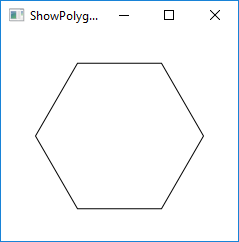
ShowPolygon.javaimport javafx.application.Application;
import javafx.collections.ObservableList;
import javafx.scene.Scene;
import javafx.scene.layout.Pane;
import javafx.scene.paint.Color;
import javafx.stage.Stage;
import javafx.scene.shape.Polygon;
public class ShowPolygon extends Application {
@Override // Override the start method in the Application class
public void start(Stage primaryStage) {
// Create a scene and place it in the stage
Scene scene = new Scene(new MyPolygon(), 400, 400);
primaryStage.setTitle("ShowPolygon"); // Set the stage title
primaryStage.setScene(scene); // Place the scene in the stage
primaryStage.show(); // Display the stage
}
/**
* The main method is only needed for the IDE with limited
* JavaFX support. Not needed for running from the command line.
*/
public static void main(String[] args) {
launch(args);
}
}
class MyPolygon extends Pane {
private void paint() {
// Create a polygon and place polygon to pane
Polygon polygon = new Polygon();
polygon.setFill(Color.WHITE);
polygon.setStroke(Color.BLACK);
ObservableList<Double> list = polygon.getPoints();
double centerX = getWidth() / 2, centerY = getHeight() / 2;
double radius = Math.min(getWidth(), getHeight()) * 0.4;
// Add points to the polygon list
for (int i = 0; i < 6; i++) {
list.add(centerX + radius * Math.cos(2 * i * Math.PI / 6));
list.add(centerY - radius * Math.sin(2 * i * Math.PI / 6));
}
getChildren().clear();
getChildren().add(polygon);
}
@Override
public void setWidth(double width) {
super.setWidth(width);
paint();
}
@Override
public void setHeight(double height) {
super.setHeight(height);
paint();
}
}
Maintained by John Loomis, updated Sun Feb 11 11:57:12 2018