EGR 203 Electric and Electronic Circuits Assignment 9
- Given the following circuit, shown below for t < 0.
The switch is closed at t = 0. Determine the time constant of
the circuit for t > 0.
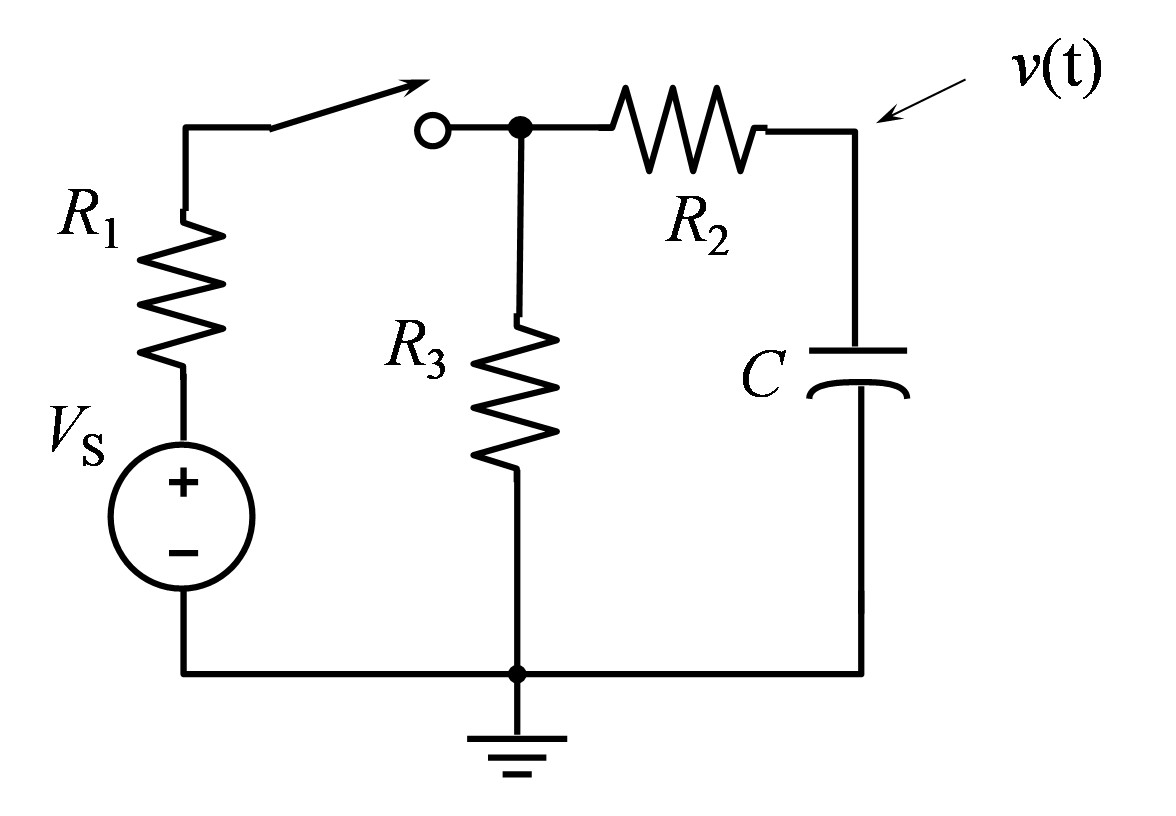
| VS | R1 | R2 | R3 | C
|
|---|
| 12 V | 4 kΩ | 80 kΩ | 6 kΩ | 150 μF
|
- A voltage v(t) = 10 cos(2000πt) is applied to
each of the following components. Find the complex impedance of each element.
- 100-mH inductance
- 10-μF capacitance
- 100-Ω resistance
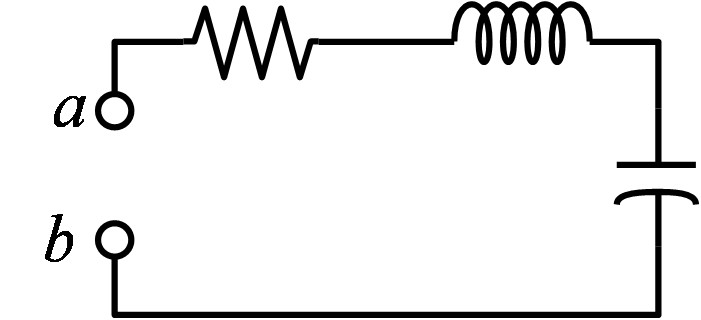
- Find the complex impedance across terminals a and b
if L = 250 mH, C = 20 μF, and R = 300 Ω.
Do the calculation for ω = 500 and then repeat for ω = 250
and ω = 1000. Show both cartesian and polar (phasor) forms of the
impedance.
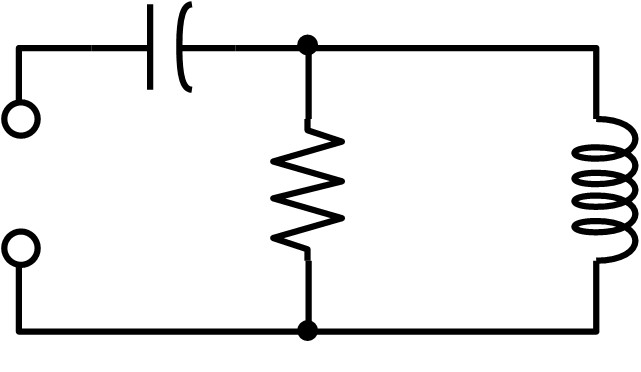
- Find the complex impedance across the terminals below
if L = 250 mH, C = 20 μF, and R = 300 Ω.
Do the calculation for ω = 400 and then repeat for ω = 200
and ω = 800. Show both cartesian and polar (phasor) forms of the
impedance.
- If the current through and the voltage across a component in
an electric circuit are
i(t) = 17 cos(200π t -
π/12) mA
v(t) = 3.5 cos(200π t -
1.309) V
determine (use the AC form of Ohm's Law and the definitions of
impedance)
- the complex impedance
- whether the component is resistive, inductive, or capacitive.
Assume there may be a resistor in series with either a capacitor or
an inductor.
- the value of the component in ohms and either farads or henries.
Maintained by John
Loomis, last updated 8 March 2013