EGR 203 Electric and Electronic Circuits Assignment 10
- Given the following circuit with C = 31.25 nF, R
= 2 kΩ, and L = 500 mH. Find the
steady-state (AC) expression for i and vout if
vg = 64 cos(8000t) V.
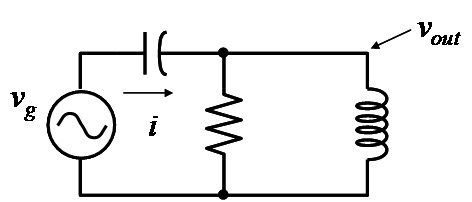
- Use Multisim (AC analysis) to plot the AC response of the above
circuit as a function of frequency between 100 Hz and 10kHz.
- Given the following circuit with C = 0.4 µF, R
= 400 Ω, and L = 40 mH. Find the
steady-state (AC) expression for i and vout if
vg = 750 cos(5000t) mV.
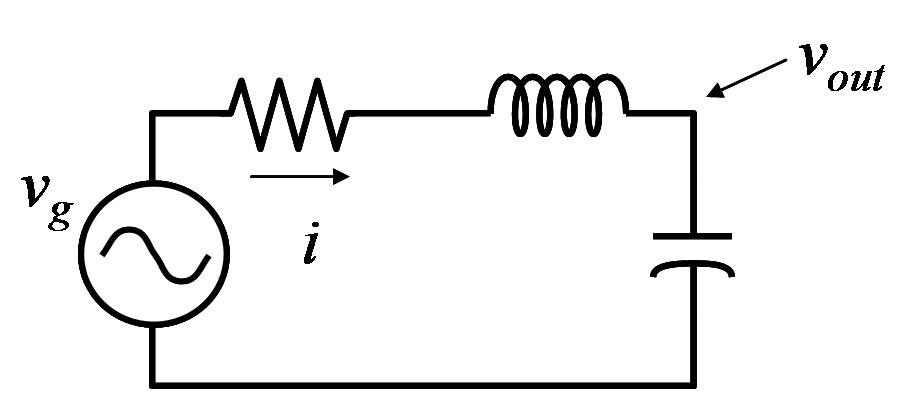
- Use Multsim (AC analysis) to plot the AC response of the above
circuit as a function of frequency between 100 Hz and 10 kHz.
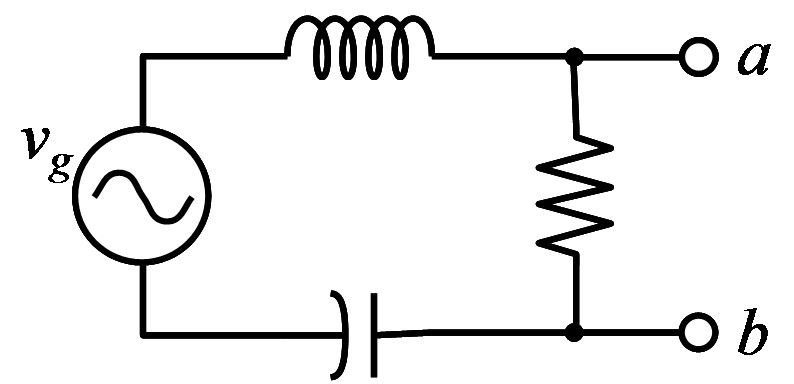
- Given the following circuit with C = -j22
Ω, R = 24 Ω, and L = j40 Ω. Find the
Thévenin equivalent circuit with respect to terminals a and
b if
vg = 75Ð0° V.
- Given C = 0.4 µF, L = 10
mH, and R = 330 ohms. For the following, calculate actual
frequency (Hz), not angular frequency (radians/sec).
- Find the frequency at which the phase shift of the RC circuit
is -45 degrees.
- Find the frequency at which the phase shift of the RL
circuit is 45 degrees.
- Find the resonant frequency (fr) for an R-(LC) circuit.
- Find the bandwidth B = fr / Q
and quality factor Q = R sqrt(C/L).
What are the units of Q?
Maintained by John
Loomis, last updated 3 July 2014